Canadian vs US Mortgages: Key Differences Explained
Canadian Mortgages Work Differently Than You Expect: 5-Year Terms, Amortization and the Stress Test Explained (2026)
If you grew up with American mortgage terms, Canadian mortgages can feel backwards. The loan can be spread over 25 or 30 years, but the interest rate usually resets every five years or sooner. That difference confuses a lot of people. This post explains the basics in plain English.
Term vs Amortization
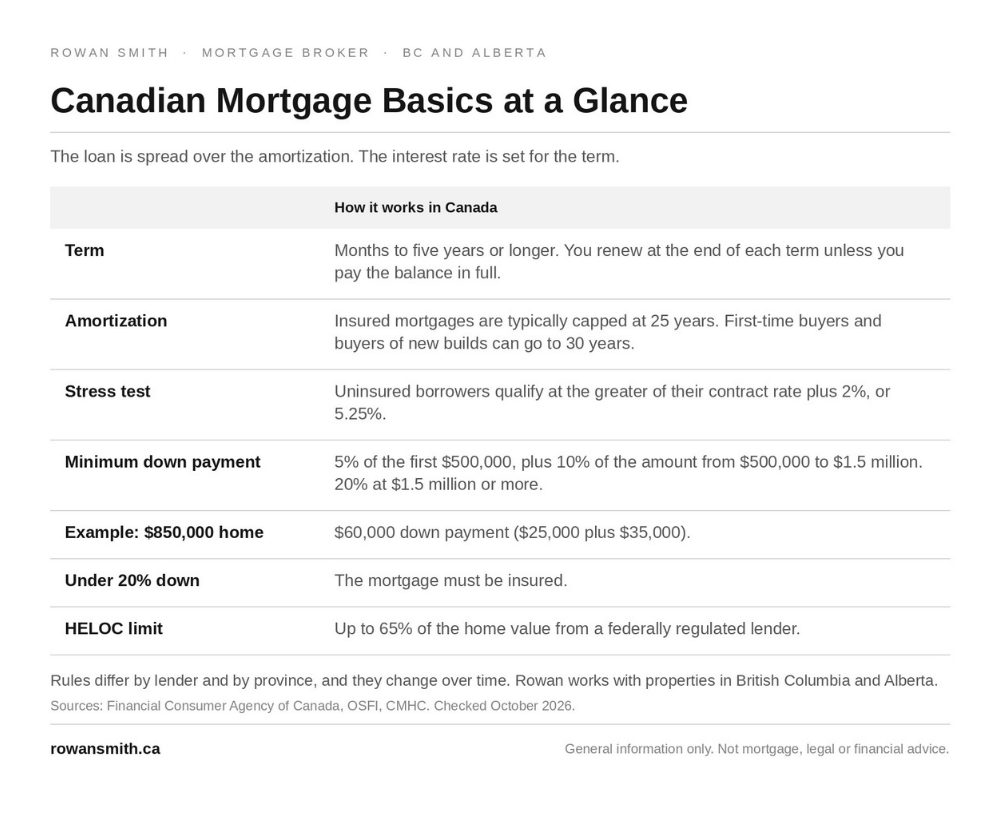
The term is how long your current mortgage agreement lasts. It can run from a few months to five years or longer. You renew at the end of each term unless you pay off the balance.
The amortization is how long it would take to pay off the whole loan. Insured mortgages are typically capped at 25 years. Since December 2024, first-time buyers and buyers of newly built homes can go up to 30 years on an insured purchase.
In the US, a 30-year fixed-rate mortgage is common, and the rate stays the same for the full 30 years. In Canada, the rate is usually fixed only for the term, then it is renegotiated.
"In Canada, the loan lasts for the amortization. The rate lasts for the term."
Fixed vs Variable
A fixed rate stays the same for the length of your term. A variable rate moves with your lender's prime rate during the term.
Either way, you face a new rate when the term ends. That is why renewal matters so much in Canada.
The Stress Test
Federally regulated lenders must qualify uninsured borrowers at the greater of their contract rate plus 2%, or 5.25%. OSFI, the federal regulator, reviews that rule at least once a year. In plain terms, a lender checks that you could still afford payments at a higher rate than the one you will actually pay.
Down Payment and Mortgage Insurance
The minimum down payment is 5% of the first $500,000 of the price, plus 10% of the portion between $500,000 and $1.5 million. A home at $1.5 million or more needs at least 20% down. If you put down less than 20%, the mortgage must be insured.
For example, an $850,000 home needs at least $60,000 down. That is $25,000 for the first $500,000 and $35,000 for the remaining $350,000.
HELOCs, Reverse Mortgages and Hard Money in Canada
Terms like HELOC, reverse mortgage, and hard money lender show up in a lot of American content. They exist in Canada too, but they work under Canadian rules and sometimes go by different names.
For example, a HELOC from a federally regulated lender is capped at 65% of the home's value.
Rowan has written about each of these. You can read his posts on equity lending, reverse mortgage vs HELOC vs downsizing, and what hard money means in Canada.
This post explains how Canadian mortgages work. Rules differ by lender and by province, and they change over time. Rowan works with properties in British Columbia and Alberta.
Have questions about how a Canadian mortgage works? Reach out to Rowan for a plain-English, no-pressure conversation.