Private Financing for Alberta RV Parks - What Buyers Need to Know
Alberta RV Parks Keep Showing Up on Serious Buyers' Radar and Here Is How the Financing Actually Works (2026)
Why Alberta RV Parks Keep Coming Up in Mortgage Conversations
A lot of people who run their own business have looked at an Alberta campground and thought: that makes sense. Buy a property, run it yourself, build something that earns income and has land underneath it.
Then they call a bank. And the bank looks at last year's declared net income, runs it through its formula, and comes back with a no.
If that is where you are, the problem is not the deal. The problem is the lender.
What the Numbers on Alberta Are Actually Showing
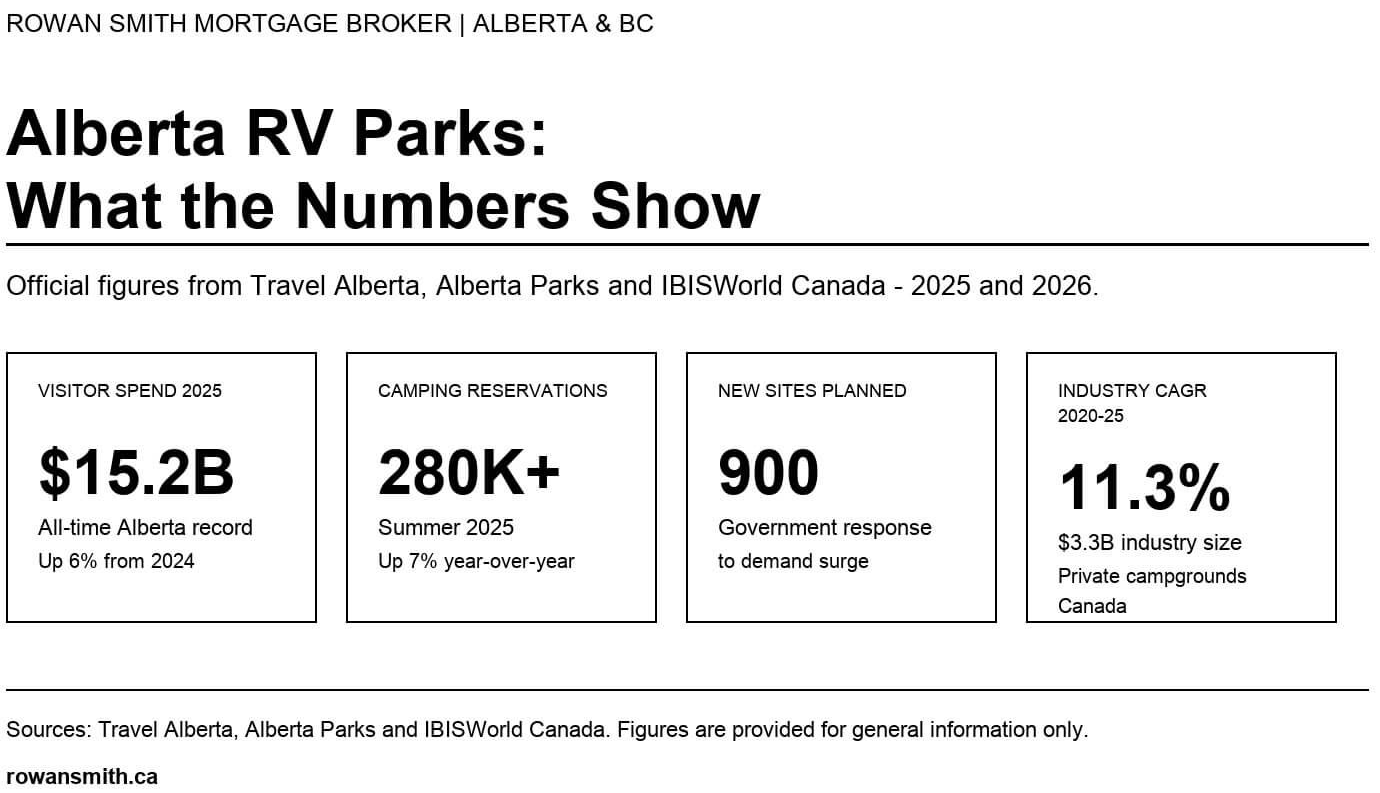
These are facts from official and industry sources. Make of them what you will.
Alberta's visitor economy hit $15.2 billion in 2025. That is a new all-time record, and Alberta was the only major province in Canada to see growth from both overseas and U.S. travellers that year, at a time when U.S. visitor numbers were falling nationwide.
Public campground demand is outpacing supply. Alberta Parks reported more than 280,000 summer camping reservations in 2025, up 7 percent from the year before. The provincial government responded with a plan to add 900 new campsites, which tells you something about what the current supply situation looks like.
Canadians are staying home. With cross-border travel declining sharply in 2025, demand for domestic camping and outdoor recreation in Alberta has increased significantly. Campgrounds that previously served a mix of Canadian and American travellers are now seeing stronger domestic demand to fill any gaps.
The private campground market in Canada is a $3.3 billion industry. It grew at an 11.3 percent compound annual growth rate between 2020 and 2025.
None of that means every campground for sale in Alberta is a good purchase. Due diligence matters enormously with the financials, the land tenure, the infrastructure, and the financing structure all needing to work. But it does explain why we have been fielding more questions about this than ever before, and why buyers who are serious about this type of property are moving with more urgency than they were two years ago.
Alberta is running out of public campsite capacity, and the government is saying so publicly. Private parks will fill the gap, which is just a matter of time.
Challenges of Financing a Commercial Real Estate Property If You Are Self-Employed
Buying a campground as a self-employed borrower means dealing with two things at once: a lender who cannot easily read your income and a property type most lenders do not know how to underwrite.
Either one leads to denials, as lenders are often hesitant to support these applications. Together, they eliminate most conventional lenders entirely. That is not the end of the conversation. It is just the starting point for a different one.
Traditional bank underwriting is tailored for T4 employees with steady, verifiable earnings. Buying a seasonal business property as a self-employed individual couldn't be further from that standard model.
Where Private Financing Comes In
Private lenders in Alberta and BC are not running your application through the same scorecard as a bank. They look at the equity in the deal: your down payment relative to the property's appraised value, and the property itself. A well-located campground with a real history of seasonal revenue is real security, regardless of what your personal tax return shows.
For self-employed buyers, this is often the most direct path to getting a campground purchase closed. Bring a meaningful down payment, make sure the property has land value that supports the loan, and a private lender can move on the file where a bank would spend two months asking questions before declining.
Private commercial mortgages are short-term, typically one to three years, and carry a higher rate. But the goal is not to stay in private financing. The goal is to close the purchase, run the business, and build the track record that eventually qualifies you for conventional commercial lending at a better rate.
What Strengthens Your File
- The size of your down payment. A 35 to 40 percent down payment changes the conversation significantly, regardless of your personal income picture.
- The property's existing financial history. If the seller has three years of verified revenue, that income supports the lending case even when your personal income does not.
- Freehold land. Leasehold properties are harder to finance across the board, and more so for self-employed borrowers.
- Your exit plan. How does the file look in 18 to 24 months? What changes so you can refinance into conventional financing?
- Home equity if you own property in BC or Alberta. Significant equity in a primary residence can sometimes be structured alongside a campground purchase to strengthen the overall financing picture.
If you already own a home with equity in BC or Alberta, there may be a way to use that equity as part of the financing structure for a campground purchase. This is worth discussing before you assume the only option is a standard commercial mortgage.
What a Real Estate Investment like this actually means to you
Not every campground purchase works with private financing. The deal needs enough equity, the property needs real land value, and there needs to be a realistic exit when the private term ends.
What is worth knowing is that the bank's no is not everyone's no. There are lenders who understand seasonal income, who can work with a self-employed borrower who has a real down payment and a good property, and who can move on a file in weeks rather than months.
Running your own business and looking at an Alberta campground? Call Rowan before you call the bank. He will tell you what the financing picture actually looks like for your situation.