
Hard Money Lender In Canada - What It Means in BC (2026)

You Searched for a Hard Money Lender in Canada, and Here Is What That Term Actually Means in British Columbia (2026)
If you searched for a hard money lender in Canada and landed here, there is a good chance you are trying to figure out whether that type of financing exists in this country and what it is actually called.
The short answer is yes, it exists. The longer answer is that the Canadian mortgage market uses different language and different rules than what you may have come across elsewhere. This post breaks down what hard money means in a Canadian context, how it works in British Columbia AND Alberta specifically, and what to think about before you move forward.
What Hard Money Means and Where the Term Comes From
Hard money is a term used to describe short-term, asset-based lending where the property is the primary basis for the loan. The lender focuses on the value of the real estate and how much equity is in it, rather than the borrower's income, credit score, or employment history.
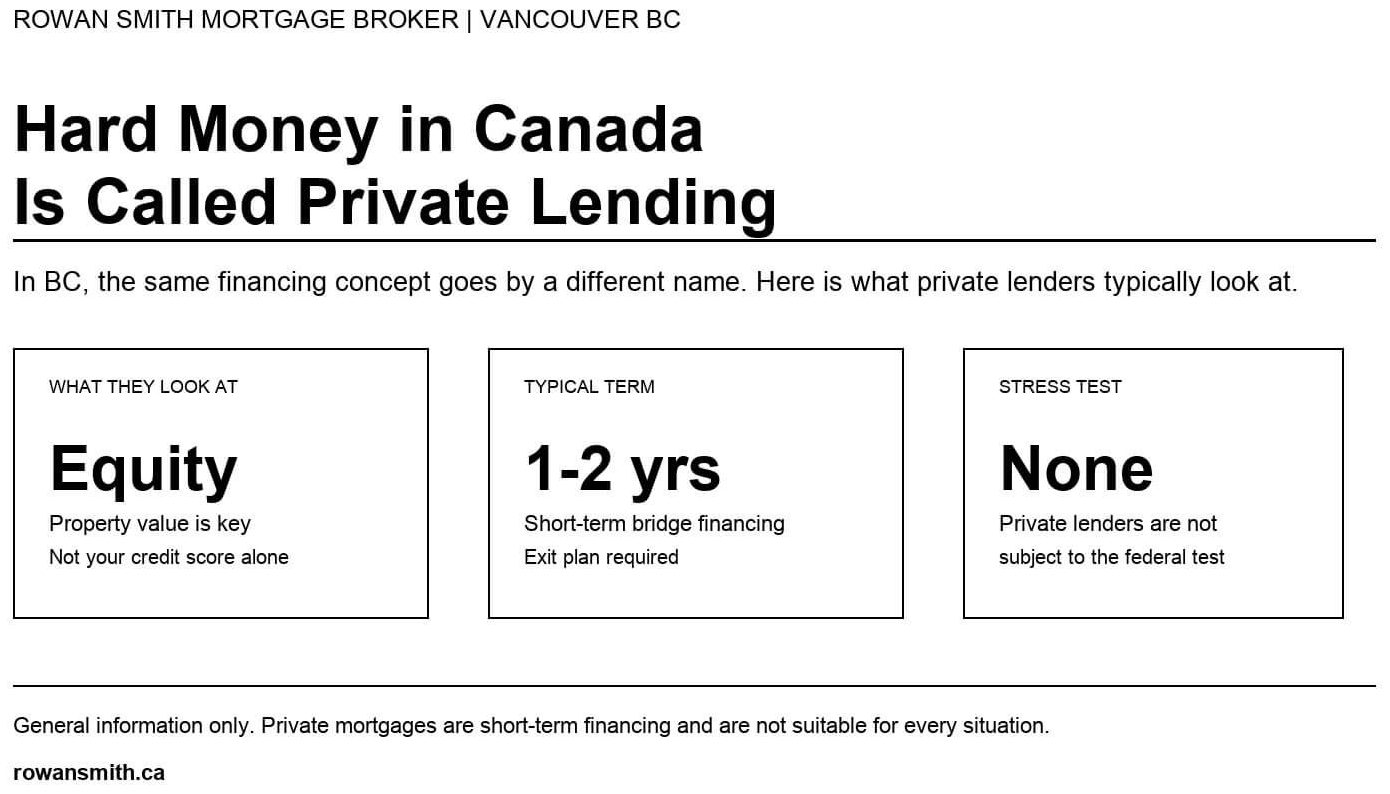
The term is widely used in real estate investing content online. In Canada, the same type of financing exists, but it is generally referred to as private lending or private mortgage lending. The underlying concept is the same: a non-bank lender provides short-term financing secured against real property, with approval driven primarily by the asset rather than the borrower's financial profile.
How Private Lending Works in British Columbia
In BC, private lenders are individuals, companies, or pools of capital that lend money secured against real estate. They are not banks or credit unions. They are not subject to the federal mortgage stress test. And they look at a mortgage application very differently than a traditional lender does.
The key question a private lender asks is: how much equity is in the property, and is there enough cushion to protect the loan if something goes wrong?
If the equity position is strong, private lenders in BC can often move quickly and approve files that a bank would decline. This makes private lending useful in a specific set of situations: when timing matters, when income is hard to document, when credit has been bruised, or when the property itself is unusual.
Private mortgage terms in BC are typically short, usually one to two years. The rates are higher than what a bank charges, and there are fees involved, including lender fees, appraisal costs, and legal fees for a BC notary or lawyer to register the mortgage. This is not a long-term financing solution. It is a bridge.
Who Typically Uses This Type of Financing in BC
Private lending in BC serves a wide range of situations. Some of the most common include:
- Self-employed borrowers whose declared income on paper does not reflect what they actually earn, making it difficult to qualify through a bank.
- Homeowners who need to access equity quickly without breaking an existing mortgage at a good rate.
- Borrowers who have been through a consumer proposal or bankruptcy and are rebuilding their financial profile.
- Real estate investors who need fast, flexible financing for a purchase or renovation project.
- People dealing with a time-sensitive situation, such as a closing date that does not align with when traditional financing can be arranged.
In all of these cases, the common thread is that the borrower has real property value and a legitimate reason why the standard bank process does not fit their situation.
What to Know About Buying Property in Canada Right Now
If you are considering purchasing property in British Columbia and you are not yet a Canadian citizen or permanent resident, there is an important piece of legislation to be aware of before you go further.
The Government of Canada introduced the Prohibition on the Purchase of Residential Property by Non-Canadians Act, which came into force on January 1, 2023. In February 2024, the Government of Canada announced a two-year extension to this ban, which now runs until January 1, 2027.
This legislation means that foreign commercial enterprises and people who are not Canadian citizens or permanent residents are generally prohibited from purchasing residential property in Canada during this period.
This post does not constitute legal or immigration advice. The rules around this legislation are specific and fact-dependent. Anyone considering a property purchase in Canada should speak with a qualified Canadian lawyer before making any decisions.
The full details of the Act, including any exemptions that may apply in specific circumstances, are available directly on the Government of Canada website at canada.ca
What This Means If You Are Already in Canada
If you are living and working in Canada, or if you are a permanent resident, the foreign buyer ban does not apply to you. You are treated the same as any other Canadian borrower when it comes to purchasing property and arranging financing.
That means the full range of mortgage options available in BC is potentially accessible to you. That includes standard bank mortgages, alternative lender products, and private lending for situations where those options are not the right fit.
If you are a permanent resident or Canadian citizen and you are trying to understand your financing options in Greater Vancouver or the Fraser Valley, that is the conversation Rowan has every day.
Private Lending: A Strategic Tool, Not a Final Resort
Far from being reserved strictly for emergencies, private lending serves as a practical, widely used tool within British Columbia’s mortgage market. Real estate investors, self-employed individuals, and a variety of property owners regularly draw on private financing.
Success with a private loan hinges on a solid exit strategy. Since private mortgages function as short-term financing, setting a clear trajectory for what follows is just as essential as securing the initial loan. Outlining how your financial picture or property will position you to transition into a long-term loan over the next one to two years ought to be determined at the very beginning.
One thing worth clarifying before you move forward: private lending in BC is not a product for desperate situations only. It is a legitimate part of the mortgage landscape used by investors, self-employed borrowers, and homeowners in a wide range of circumstances.
What makes it work is having a clear plan for what comes next. Because private mortgages are short-term, the exit strategy matters as much as the entry. What changes in the next one to two years will allow you to refinance into a better product? That question should be answered before you start, not after.
"A good mortgage broker helps you understand what the deal actually costs and what comes after it."
Where to Go From Here
If you are exploring financing options in BC and want to understand how private lending works for your specific situation, the best starting point is a straightforward conversation with a licensed mortgage broker.
If you want to keep reading, Rowan has written plain-English guides on several related topics:
- How private lending works in Vancouver and who it is actually for.
- What construction mortgages look like in BC and how the draw process works.
- How self-employed borrowers can qualify for a mortgage using the Sagen Alt-A program.
- How to access your home equity in BC without selling your property.
Each of those posts links back to this one and covers a different part of the financing picture. Start with whichever one matches where you are right now.
Have a question about mortgage financing in BC?
Contact Rowan for a free, no-obligation conversation. He works with a wide range of borrowers across Greater Vancouver and the Fraser Valley and will give you a straight answer about what your options look like.